
Sizing
What Size Dumpster Do I Need? An Honest Local Guide
Most guides ask you to estimate cubic yards. Around here the answer usually turns on whether there is a basement involved.
Start with the material, not the number
Almost nobody can estimate their own debris in cubic yards, and guides that ask you to are not much help. We ask three things instead: what are you throwing out, roughly how much in terms you can picture, and where will the container sit.
Those three answers pick the size reliably. The cubic yard figure is just the label on the box.
Volume and weight, and which binds first
Every container has two limits and you will hit one of them first. Volume is obvious — you cannot load above the top rail. Weight is the one people forget and the one that costs money.
Each size includes a tonnage allowance: roughly one to two tons on a 10 yard, four to five on a 30. Past that you pay a per-ton overage, which we quote before you book.
What each size really holds
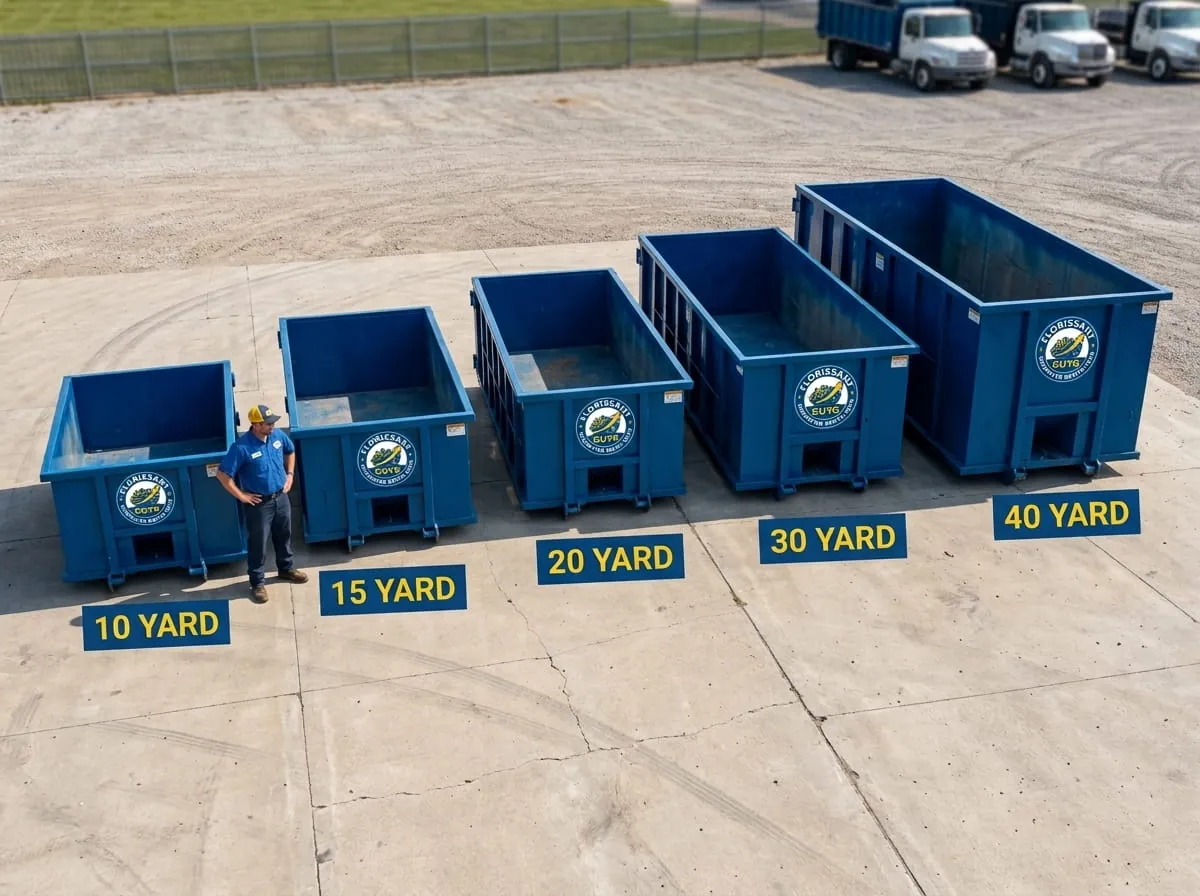
10 yard — 12 ft × 8 ft × 3.5 ft
Three to four pickup loads, one to two tons. The small-job container and, more importantly here, the heavy material container: concrete, brick, tile, soil and clay. Low sides mean you can throw material over the wall without a ramp.
15 yard — 16 ft × 8 ft × 4 ft
Five to six pickup loads, two to three tons. The under-used size, and the one we place most often in the tighter inner-ring streets — Ferguson, Jennings, Overland, Normandy and the smaller municipalities — where sixteen feet fits a short driveway and twenty-two does not.
20 yard — 22 ft × 8 ft × 4.5 ft
Seven to eight pickup loads, three to four tons. Our most common residential container and the default across the post-war subdivisions of Florissant, Black Jack, Hazelwood and Bellefontaine Neighbors, where driveways are generous.
30 yard — 22 ft × 8 ft × 6 ft
Ten to twelve pickup loads, four to five tons. Same footprint as the 20 with eighteen more inches of height, so it holds half again as much without needing more driveway. The right call for a whole-house clear-out, a large basement, or a job site.
Worked examples from local jobs
| Job | Size | Why |
|---|---|---|
| Bathroom renovation | 10 yard | Small volume; tile and cast iron are dense |
| Patio or driveway slab removal | 10 yard | Concrete runs ~2 tons per cubic yard |
| Soil or clay excavation | 10 yard | Heavier than almost anyone estimates |
| Kitchen renovation | 15-20 yard | Cabinetry eats volume; tile drives weight |
| Inner-ring street, any job | 15 yard | Access is the limit, not volume |
| Composition re-roof, 24 squares | 20 yard | Around 4 tons — at the allowance |
| Full garage clear-out | 20 yard | Bulky and light — fills volume first |
| Full basement clear-out | 20-30 yard | Decades of storage; volume binds first |
| Three-bed whole-house clear-out | 30 yard | Contents fill volume before weight |
| Mature tree removal | 20-30 yard | Cut it down first; it halves the volume |
| Storm damage, whole yard | 30 yard | Bulky, light, and arrives all at once |
| Pre-war renovation | Size down | Plaster and cast iron are far heavier |
The basement factor
The single biggest difference between sizing a job here and sizing the same job in much of the country.
Nearly every house in north St. Louis County has a full basement. That is not extra living space so much as extra storage space, and on a house that has been in one family for decades it is usually full.
What that means when you are sizing:
- Add a size to whatever you first thought for any clear-out that includes the basement.
- Basement contents are bulky and light — boxes, furniture, old appliances, paperwork, holiday decorations, exercise equipment. Volume binds long before weight.
- Getting it up the stairs is the real work. Place the container as close to the door you will actually use as we can get it. Fifteen extra feet of carry, repeated three hundred times, is the whole job.
- Check for water damage before you start. Anything that sat damp is heavier and may need handling differently.
- Old paint, chemicals and fuel live in basements here. Pull them before anything else moves — they have their own route.
Older housing weighs more
Our service area spans a genuinely wide range of building ages, and it changes the arithmetic.
The post-war tracts — most of Florissant, Black Jack, Bellefontaine Neighbors, St. Ann — are drywall over stud, and modern-ish materials throughout. Sizing there is predictable.
The inner-ring cities — Ferguson, Jennings, Overland, Normandy — have a good deal of pre-war housing, and that changes things:
- Plaster and lath is dramatically heavier than drywall for the same wall area.
- Dimensional lumber is denser than modern framing.
- Cast iron plumbing weighs many times what plastic does — and is worth pulling as scrap.
- In any building predating 1980, have floor tile, pipe lagging and textured ceilings tested before demolition starts.
The rule of thumb: for pre-war renovation, size down one and expect to fill it.
Heavy material goes small
The other end of the range, and where overage charges come from.
Concrete runs around two tons per cubic yard. Driveway, patio, footings, steps and brick all go in a 10 yard, part-filled — and clean concrete has a cheaper route anyway.
Soil and clay run roughly 1,800 to 2,200 lb per cubic yard, more when wet, and a lot of this region sits on heavy clay. Covered in detail here.
Tile, plaster and roofing are all weight-driven rather than volume-driven.
For all of these, you get volume through swaps, not through a bigger container.
How to describe your job on the phone
- What the material is. "Kitchen cabinets, countertop, appliances and 200 square feet of tile" tells us everything.
- Whether the basement is included. It changes the answer more than anything else.
- Roughly when the house was built. Pre-war and post-war size differently.
- Whether there is concrete, brick or soil. Those get their own small container.
- Which city. North county is a mosaic and the rules change at every line.
- Driveway surface and width, and any low branches. We need about twenty-two feet of clear height, and the canopy on some of these streets is genuinely low.
Ninety seconds on the phone is the difference between a flat rate that holds and a truck that has to leave again.
Need a container in Florissant?
Call and describe the job. Three minutes on the phone gets you a size recommendation, a flat rate and a delivery window — and we will tell you if a smaller, cheaper container is the right answer.
Call (314) 551-9244