
Construction
Where Construction Debris Actually Goes Around Florissant
Missouri permits demolition landfills as a separate category from municipal ones. Knowing that is worth money on any job producing real tonnage.
Why city collection does not fit
Residential collection across north county is a cart service, and in Florissant it is capped at 210 gallons a week with overages billed per bag and booked 24 hours ahead.
A renovation produces drywall, plaster, timber, tile, cabinetry, flooring and roofing in volumes that would swamp that in an afternoon. Demolition produces concrete by the ton. It is not a criticism of the service — it is simply not what a cart system is for.
Missouri permits three kinds of disposal area
Worth understanding, because it explains why segregation saves money here rather than just being tidy.
The Missouri Department of Natural Resources regulates solid waste under 10 CSR 80-2, and permits three main types of disposal area:
- Sanitary landfills — municipal solid waste
- Demolition landfills — construction and demolition debris specifically
- Utility waste landfills — power plant ash
Each permit specifies exactly which wastes may be accepted and any special handling required. Permits are also needed to process waste — sorting, handling, recovery, consolidation, transfer or treatment — not just to bury it.
The practical consequence: a clean stream of a single material can go to a facility permitted for that material, at that facility's rate. A mixed container has to go wherever will take everything in it, which is generally the most expensive option available.
The state runs this through 20 solid waste management districts; Florissant sits in the St. Louis-Jefferson district.
The five streams worth separating
1. Clean concrete, brick, block and asphalt
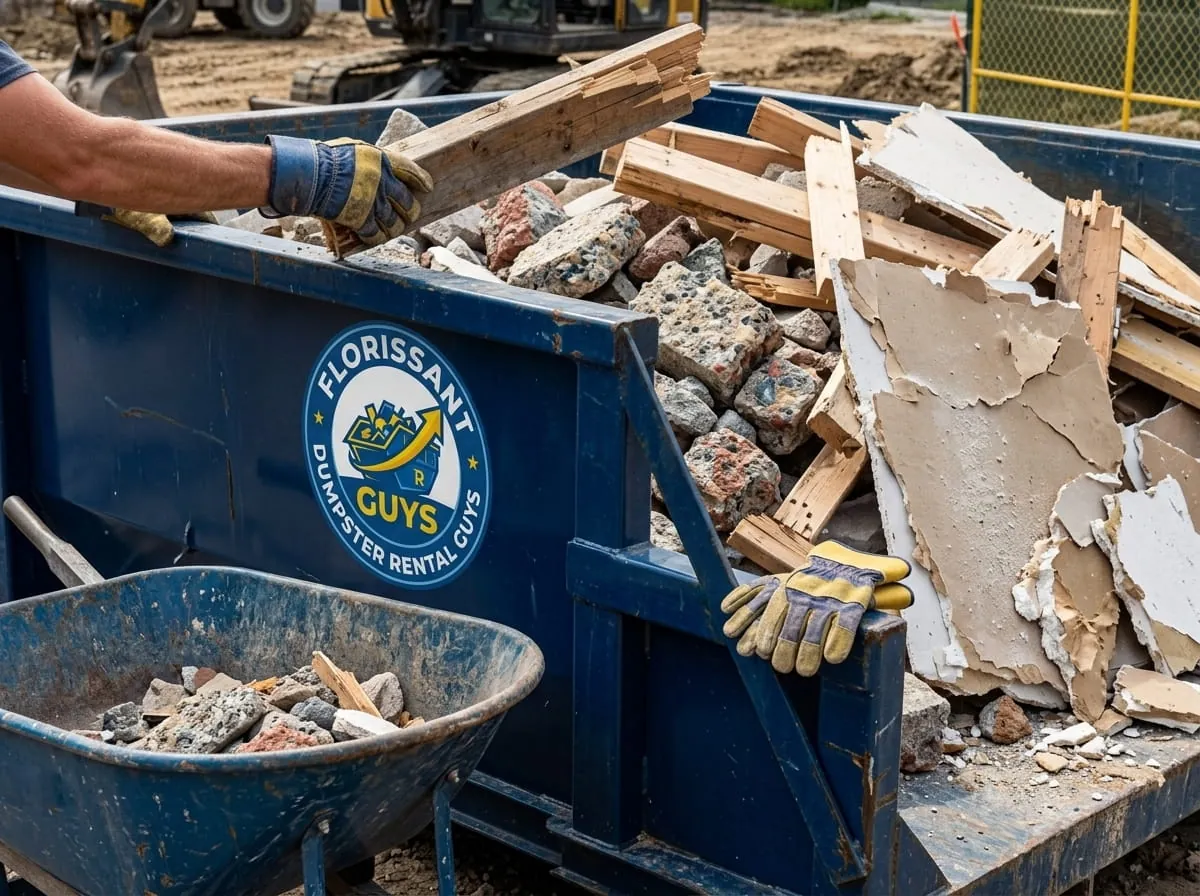
Accepted as its own named category at the regional facility, separately from general construction debris. Rebar is generally fine; timber, plastic and general rubbish are not. Its own 10 yard, part-filled. On a demolition job this is usually the single largest tonnage and the biggest saving available.
2. Clean fill soil
Also its own category. Keep roots, sod, timber and plastic out of it. Covered in detail here.
3. Scrap metal
Ductwork, water heaters, structural steel, rebar offcuts, fencing and — in the older housing across the inner-ring cities — cast iron plumbing, which is heavy and genuinely valuable. Positive value rather than a disposal cost.
4. Cardboard and packaging
New-build and fit-out work generates it in enormous volume and it fills a container faster than anything else on site. Flattening it is the cheapest volume saving available anywhere.
5. Yard waste and land clearing
Not optional here — the regional facility refuses yard waste outright and directs it to green waste recycling. Detail here.
Concrete and clay: the weight traps
Concrete runs around two tons per cubic yard. Slab, footings, driveway, patio, steps and brick all belong in a 10 yard, part-filled. A large container of concrete is unhaulable long before it looks full.
Clay is the local addition. Much of this region sits on heavy clay subsoil, which runs around a ton or more per cubic yard and considerably more when wet. Footing and utility trenching routinely produces far more weight than the volume suggests, and after a wet spell it gets worse.
Plaster and lath deserves its own mention. In the pre-war housing of Ferguson, Jennings, Overland and Normandy, interior demolition produces plaster rather than drywall, and plaster is dramatically heavier for the same wall area. Size those jobs down and expect to fill the container.
What the regional facility refuses
Champ Landfill in Maryland Heights publishes its list, and since it takes most of north county's waste, the list is worth knowing before you load.
Refused: major appliances, bulk liquids, explosives, highly flammable or volatile substances, propane gas containers, radioactive materials, regulated infectious waste, regulated quantities of hazardous waste or PCB, septic tank pumpings, whole tires, toxic waste, waste oil and yard waste.
On a job site the ones that come up are:
- Whole tires — chipped or shredded only. Site tires need a separate route.
- Major appliances — scrap metal route, not the container.
- Waste oil and bulk liquids — plant and equipment fluids need proper handling.
- Propane cylinders — including the ones on a site heater.
- Yard waste — site clearance vegetation is a separate stream from day one.
One practical note for anyone self-hauling: every customer at the facility must wear a hard hat, safety vest and safety glasses. They are sold at the scale house, but turning up without them wastes the trip.
Older buildings and the asbestos question
This matters more here than in most markets because of the age profile of the housing.
North county spans everything from pre-war inner-ring housing through the enormous 1950s and 60s build-out. That means a very large share of the building stock predates 1980.
In any building of that age, have floor tile, pipe lagging and insulation, siding, roofing felt and textured ceilings tested before demolition begins. Asbestos-containing material never goes in a container, and discovering it mid-demolition is far more expensive and disruptive than testing for it first.
Demolition permits in many municipalities carry their own survey conditions, so this is often a requirement rather than a precaution. Your municipality is the authority.
Job-site setup that saves money
- Place containers where the work is, not where they are convenient for the truck. Labor spent walking debris across a site is the largest hidden cost in waste handling.
- Run a separate 10 yard for concrete on any job producing it.
- Keep clean fill separate from everything else.
- Set up a cardboard point by the trades' entrance from day one.
- Start a metal pile immediately. On an older building the cast iron alone justifies it.
- Keep site vegetation out of the debris container — it is refused at the gate.
- Brief every trade on day one and again when a new crew arrives. One subcontractor can contaminate a stream.
- Check the overhead before the trades arrive — twenty-two feet, and this area has real tree canopy.
- Watch the weather. Open containers fill with water in a Missouri storm, and water is weight you pay for. Ask for a tarp on a long placement.
Scheduling around the trades
On a phased job the container schedule should follow the trade sequence rather than sitting through the whole project.
A typical renovation runs: strip-out first, the heaviest and dirtiest phase, wanting a container on site continuously; then framing and mechanical, producing steady moderate volume plus the metal stream; then finishes, producing packaging and offcuts in bursts.
Three shorter placements timed to those phases usually cost less than one long one and keep the site clearer. Tell us the build program and we will schedule around it rather than making you call each time.
Two local scheduling notes. Winter weather genuinely interrupts work here — ice storms and hard freezes both stop outdoor trades and complicate access to a driveway, so build slack into a January or February program. And spring storm season brings a surge in demand across the whole region at once; after a big event, containers get scarce for a week or two. If your program is flexible, avoid booking a swap for the week after a major storm.
Need a container in Florissant?
Call and describe the job. Three minutes on the phone gets you a size recommendation, a flat rate and a delivery window — and we will tell you if a smaller, cheaper container is the right answer.
Call (314) 551-9244