Local Rules
Why Yard Waste Has To Stay Separate in Missouri
The regional landfill lists yard waste on its unaccepted list. Not as a preference — as a refusal.
The rule in one line
Yard waste is kept out of the general municipal waste stream in Missouri, and the separation is enforced at the disposal end rather than being left to good intentions.
That is not a suggestion about best practice. A load of general debris with yard waste mixed through it is a problem at the gate, which is why every hauler in this region asks what is going in the container before quoting.
Why Missouri separates it
Two reasons, and both are practical rather than symbolic.
Landfill space. Yard waste is bulky, and burying it consumes airspace that is expensive and finite. Composted instead, it becomes a product.
Decomposition. Organic material breaking down in a landfill produces methane and leachate. Kept aerobic in a compost windrow, it produces neither in any comparable quantity.
Missouri's Department of Natural Resources regulates solid waste under 10 CSR 80-2 and operates the state through 20 solid waste management districts. Florissant sits in the St. Louis-Jefferson district, which part-funds regional recycling and household hazardous waste programs.
The state permits three main kinds of disposal area — sanitary landfills for municipal waste, demolition landfills for construction debris, and utility waste landfills — and each permit specifies exactly what may be accepted. That is why "just put it all in one box" is not available as an option.
What counts as yard waste
Broadly, anything that grew:
- Grass clippings and leaves
- Branches, brush and prunings
- Hedge and shrub trimmings
- Garden clearance and dead plants
- Sod and turf, though this is heavy — see below
- Small stumps and root balls, within reason
What does not count, and this is where loads get contaminated:
- Treated, painted or stained timber — fence posts, deck boards, landscape ties. Nearly all exterior timber on a property is treated.
- Soil and dirt. Different material with a different route entirely — covered here.
- Rock, gravel, brick and pavers.
- Plastic pots, landscape fabric, edging, irrigation line and wire.
- Bagged waste in plastic sacks, unless the sacks come out again.
The six inch branch rule
A specific and genuinely useful local detail.
Champ Landfill's accepted list includes tree branches over six inches in diameter, while yard waste as a category is excluded. The distinction is between compostable green material and what is effectively timber.
Practically, on a tree removal you have two different materials:
- Brush, leaves and small limbs — green waste, and it goes to a composting route.
- Trunk sections and large limbs over six inches — handled differently, and often welcomed by firewood cutters or mills before they ever reach a landfill.
If you are taking down a mature tree, it is worth asking your tree service to stack the trunk wood separately. It reduces what you pay us to haul and it is often worth something to somebody.
Your weekly collection, and its limits
Inside the City of Florissant, yard waste is collected by the contracted hauler as part of residential service — on the day before your trash day, alongside recycling. Miss that and it waits a week.
That works well for the ordinary rhythm of a lawn and a few shrubs. It stops working for:
- Tree removal. One mature tree is many weeks of yard waste collection.
- Whole-garden clearance, especially on a property that has been let go.
- Storm damage, which arrives all at once.
- Overgrown lots on the larger properties out toward Old Jamestown.
- Landscape rebuilds, which mix green waste with soil, rock and old timber — three different streams.
When the volume needs a container
Green waste is the classic bulky and light material, which means it sizes the opposite way from most debris.
- A few shrubs and a day's pruning: the weekly collection, spread over a fortnight.
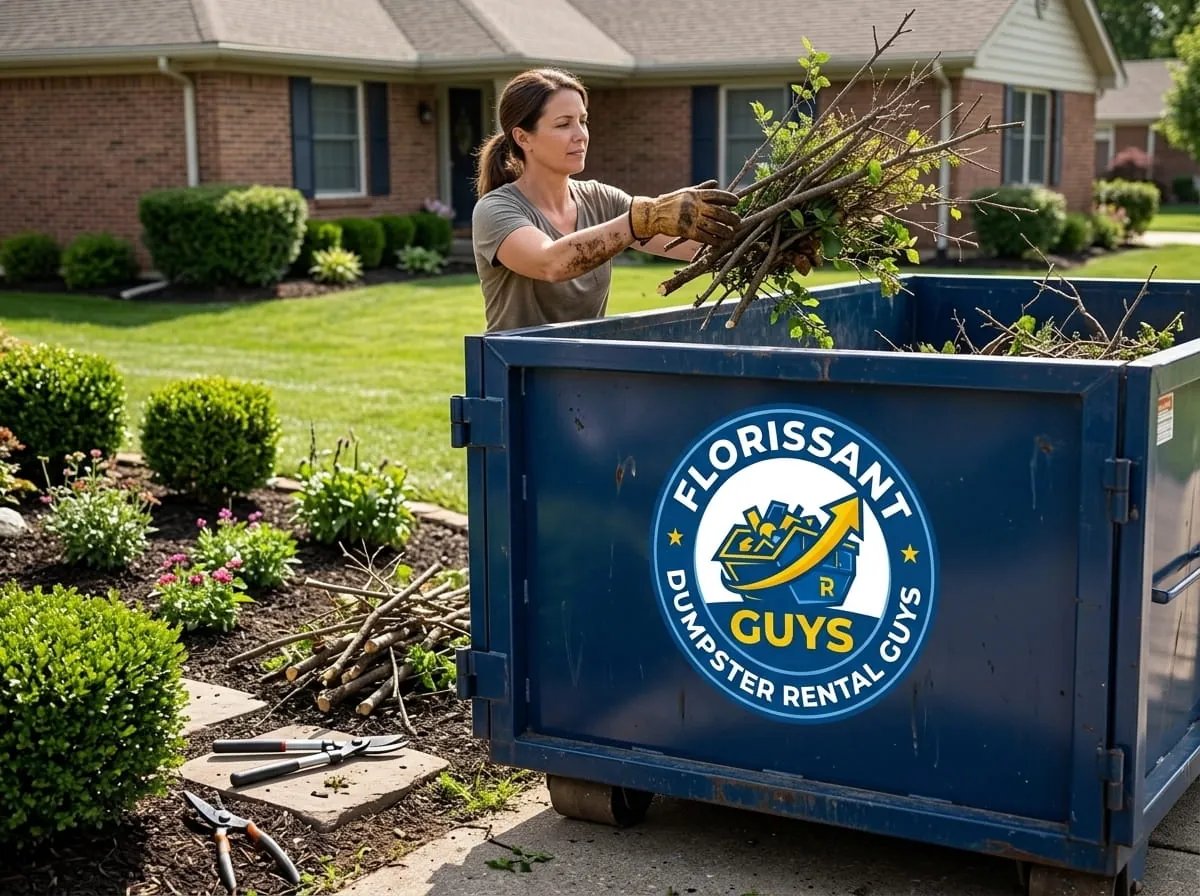
- One mature tree: a 20 or 30 yard. Branches trap enormous amounts of air.
- Whole-garden clearance: a 30 yard.
- Acreage or lot clearing: a 30 yard, and plan for more than one.
Sod and turf are the exception to "bulky and light". Soil clinging to the roots makes stripped turf genuinely heavy, so a lawn removal wants a small container part-filled rather than the large one the size of the pile suggests.
Keeping a green load clean
A clean green load has a cheaper route than mixed debris, so it is worth protecting.
- Nothing treated. One fence post can change what the load is.
- No soil. Shake root balls out where you can.
- No pots, fabric, edging or wire. These arrive with landscape work constantly.
- No bags left in. Empty them and take the plastic out.
- Tell us at booking that it is a green load, so we route it correctly rather than treating it as mixed.
On a landscape rebuild, the cheapest arrangement is usually two containers rather than one: green waste in one, hardscape and old timber in the other. It sounds like more, and it usually costs less.
Storm damage, which is its own problem
This region gets real severe weather — spring storm season, straight-line winds, and ice storms that bring down limbs across whole neighborhoods at once.
What that means practically:
- Volume arrives instantly and the weekly collection cannot absorb it.
- Everybody needs a container the same week, so availability tightens after a big event. Call early rather than waiting until the yard is tidy.
- Storm debris is usually clean green waste, which is good news — as long as it does not get mixed with fence panels and roofing on the way in.
- Damaged fencing and roofing are a separate stream from the limbs that took them down.
- Photograph everything before it moves if there is an insurance claim.
City services and facility rules vary and change. The collection arrangement above applies to the City of Florissant; other north county municipalities have their own. Confirm accepted materials with the facility or your hauler before loading anything unusual.
Need a container in Florissant?
Call and describe the job. Three minutes on the phone gets you a size recommendation, a flat rate and a delivery window — and we will tell you if a smaller, cheaper container is the right answer.
Call (314) 551-9244